


- View
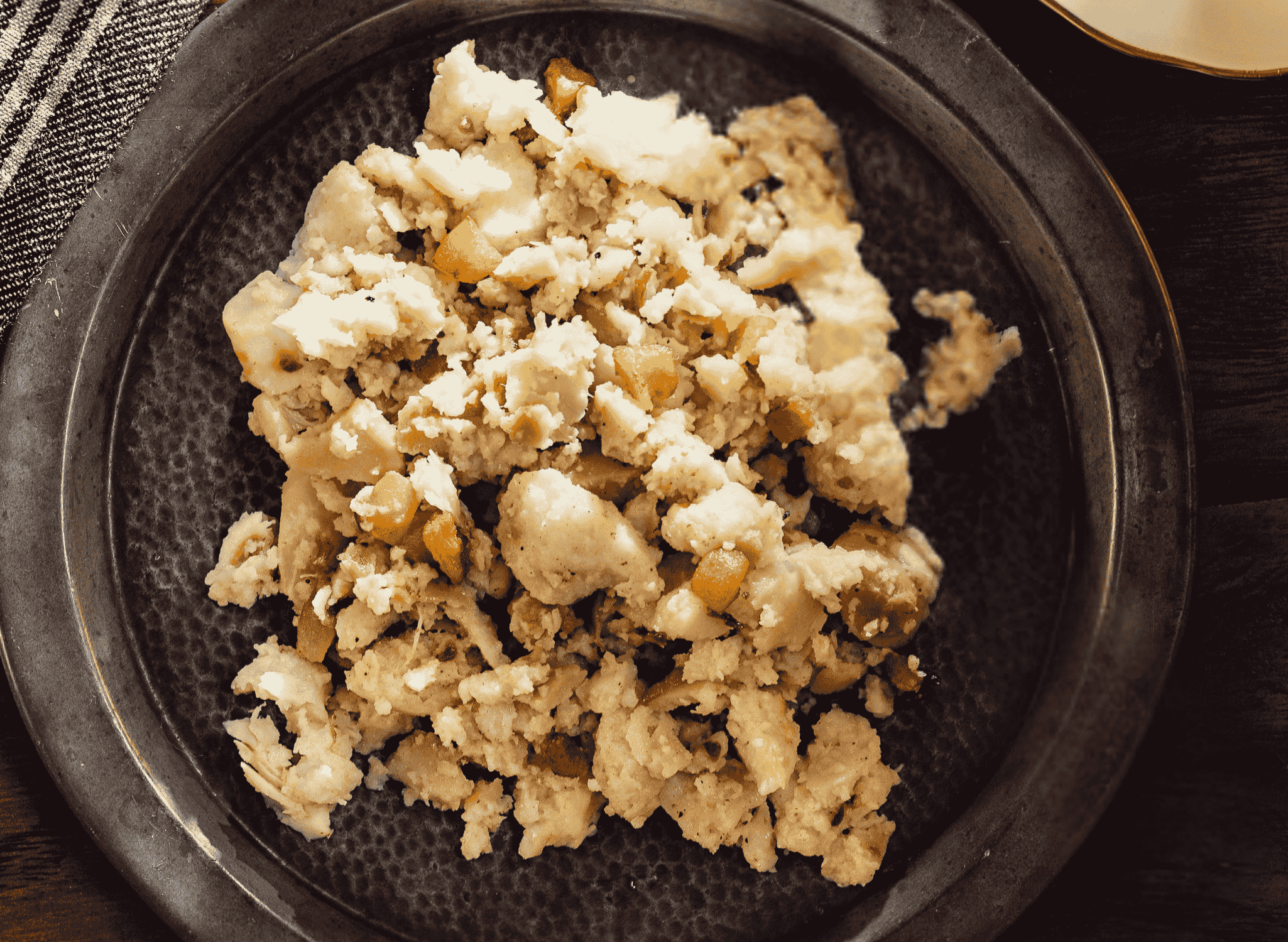
Fish and Brewis is a dish rooted in the history of Newfoundland and Labrador, where harsh winters and long sea journeys shaped how people cooked and ate. It is a meal built on two simple ingredients, salt fish and hard bread, prepared in a way that speaks of survival and ingenuity.
Though modest in its composition, it remains deeply satisfying. The fish provides a salty richness, while the bread softens into something hearty once soaked and boiled. Together they create a meal that is plain yet comforting, reflecting the land and sea that gave rise to it.
Today, Fish and Brewis is remembered as more than just sustenance. It is eaten at family gatherings, community events, and cultural celebrations. It represents the resilience of those who lived off the North Atlantic and found nourishment in what was available.
Want to dive deeper into Canadian Cuisine? Don’t miss our post on Traditional Canadian Foods to Try
What Is Fish and Brewis?
Fish and Brewis is a traditional Canadian dish that combines salted cod with hard bread, often referred to as hard tack. The cod is soaked overnight to reduce its saltiness before being gently boiled, while the bread is softened through repeated soaking and cooking.
Once prepared, the two elements are brought together on a plate, often topped with scrunchions. These are small pieces of salted pork fat fried until crisp, releasing flavourful drippings that are poured over the dish, adding richness and a crunchy texture.
It is usually served as a main meal, eaten hot, and best enjoyed in colder weather when hearty food feels most satisfying. Though humble in presentation, it holds an important place in Newfoundland kitchens and continues to be enjoyed by those with ties to the region.
Ingredients and Taste
The main ingredient is salt cod, chosen not for luxury but for its practicality. Once desalted and cooked, the flesh is firm yet flaky, offering a savoury flavour that speaks of the ocean. The bread, hard and dry at first, softens into something dense and filling after soaking.
Scrunchions are an essential addition, bringing a salty crunch that contrasts with the mildness of the bread and fish. The pork fat infuses the dish with richness, giving it a depth that the base ingredients alone cannot provide.
The flavour is straightforward, with no attempt to mask its simplicity. It is salty, hearty, and satisfying, with textures that range from soft bread to crisp pork. Each bite speaks of sustenance and resourcefulness, rather than delicacy or refinement.
A Taste of History
Fish and Brewis has its origins in the lives of fishermen and their families in Newfoundland and Labrador. Salt cod was once a lifeline for those working on the North Atlantic, preserved through salting and drying so that it could last for months at sea.
Hard bread, or hard tack, was equally practical. It was cheap, durable, and easy to store, making it a natural companion to salt fish. Together, they formed a meal that was portable, nourishing, and able to withstand long voyages and harsh conditions.
Over time, the dish became a staple of home life as well, eaten in fishing villages where supplies were limited and families relied on what was both affordable and available. Scrunchions were added later, giving the dish a taste of indulgence amid its practicality.
Today, Fish and Brewis is more than a reminder of survival. It is part of Newfoundland identity, reflecting a way of life tied to the sea. Though modern diets have changed, the dish endures as a link to heritage, celebrated in kitchens and community halls across the province.
How to Make Fish and Brewis (Salt Fish and Bread)
Fish and Brewis is a cherished traditional dish from Newfoundland and Labrador, pairing salt cod with hard bread softened in water. Expect hearty textures, briny depth, and comforting flavours. It is often finished with scrunchions, fried pork fat that adds richness and crunch. See the recipe card at the bottom for printable directions
Ingredients
For the main dish
- 500g salt cod
- 4 pieces hard bread (hard tack or ship’s biscuit)
- 2 medium onions, finely chopped
- 3 tbsp butter
For scrunchions
- 200g salt pork, diced into small cubes
For seasoning
- Freshly ground black pepper, to taste
Cooking Instructions
Step 1: Soak the salt cod
To begin, place the salt cod in a large bowl and cover generously with cold water. Soak overnight, changing the water at least twice to remove excess salt while retaining the fish’s characteristic flavour. Once soaked, move on to preparing the hard bread.
Step 2: Soak the hard bread
Place the hard bread in a separate bowl and cover generously with cold water. Leave it to soak overnight until softened. Keep the bread in its soaking water until you are ready to cook it, as this water will be used in the traditional preparation. Proceed to cooking the cod.
Step 3: Boil the cod
Drain the soaked cod and place it in a saucepan with fresh water. Bring to the boil over medium heat, then reduce the heat and simmer gently for about 15 minutes, or until the fish flakes easily. Drain well, transfer to a plate and separate the fish into large flakes. Set aside while you prepare the bread.
Step 4: Boil the bread
Place the soaked hard bread and enough of its soaking water to cover it in a saucepan. Heat slowly just until the water comes to the boil, then immediately remove the pan from the heat and drain well. Do not simmer the bread, as prolonged cooking can make it overly soft and gluey. Keep warm while you prepare the scrunchions.
Step 5: Fry the scrunchions
Place the diced salt pork in a frying pan over medium to low heat. Cook slowly until the pieces are crisp and golden and plenty of fat has rendered into the pan. Do not discard the rendered fat, as it provides much of the traditional flavour of Fish and Brewis. Continue with the onions.
Step 6: Cook the onions
Add the chopped onions to the rendered pork fat and cook for about 5 minutes, stirring occasionally, until softened. Stir in the butter, if using, and allow it to melt into the pork fat. Once the onions are tender, prepare to combine the dish.
Step 7: Combine fish and bread
Place the flaked salt cod and drained hard bread together in a large pan or serving dish. Spoon the onions, scrunchions and rendered fat over the top, distributing them evenly. Gently combine everything without excessively breaking apart the softened bread.
Final Step: Serve hot
Serve Fish and Brewis immediately while hot, spooning additional scrunchions and rendered fat over each portion. Traditionally, the combination of tender salt cod, softened hard bread and crisp pork provides plenty of flavour on its own, although mustard pickles or other Newfoundland style pickles can be served alongside for a sharp contrast.
Variations and substitutions
- Substitution for hard bread: Use day-old dried bread rolls if hard tack is unavailable, soaking them in water until softened.
- Alternative fat: Bacon can be used in place of salt pork if necessary, though the flavour will differ.
- Onion variation: Add spring onions or chives for a fresher twist.
Cooking Tips for Perfect Fish and Brewis
- Always soak cod thoroughly to avoid overwhelming saltiness.
- Drain bread carefully to keep the dish from becoming soggy.
- Render scrunchions slowly on low heat to extract maximum flavour without burning.
- Flake fish into large chunks for authentic rustic texture.
Fish and Brewis (Salt Fish and Bread)
Ingredients
For the main dish
- 500 g salt cod
- 4 pieces hard bread hard tack or ship’s biscuit
- 2 medium onions finely chopped
- 3 tbsp butter
For scrunchions
- 200 g salt pork diced into small cubes
For seasoning
- Freshly ground black pepper to taste
Instructions
- To begin, place the salt cod in a large bowl and cover generously with cold water. Soak overnight, changing the water at least twice to remove excess salt while retaining the fish’s characteristic flavour. Once soaked, move on to preparing the hard bread.
- Place the hard bread in a separate bowl and cover generously with cold water. Leave it to soak overnight until softened. Keep the bread in its soaking water until you are ready to cook it, as this water will be used in the traditional preparation. Proceed to cooking the cod.
- Drain the soaked cod and place it in a saucepan with fresh water. Bring to the boil over medium heat, then reduce the heat and simmer gently for about 15 minutes, or until the fish flakes easily. Drain well, transfer to a plate and separate the fish into large flakes. Set aside while you prepare the bread.
- Place the soaked hard bread and enough of its soaking water to cover it in a saucepan. Heat slowly just until the water comes to the boil, then immediately remove the pan from the heat and drain well. Do not simmer the bread, as prolonged cooking can make it overly soft and gluey. Keep warm while you prepare the scrunchions.
- Place the diced salt pork in a frying pan over medium to low heat. Cook slowly until the pieces are crisp and golden and plenty of fat has rendered into the pan. Do not discard the rendered fat, as it provides much of the traditional flavour of Fish and Brewis. Continue with the onions.
- Add the chopped onions to the rendered pork fat and cook for about 5 minutes, stirring occasionally, until softened. Stir in the butter, if using, and allow it to melt into the pork fat. Once the onions are tender, prepare to combine the dish.
- Place the flaked salt cod and drained hard bread together in a large pan or serving dish. Spoon the onions, scrunchions and rendered fat over the top, distributing them evenly. Gently combine everything without excessively breaking apart the softened bread.
- Serve Fish and Brewis immediately while hot, spooning additional scrunchions and rendered fat over each portion. Traditionally, the combination of tender salt cod, softened hard bread and crisp pork provides plenty of flavour on its own, although mustard pickles or other Newfoundland style pickles can be served alongside for a sharp contrast.


Recipe Reviews