- View
Few foods define a nation quite like the baguette defines France. This slender loaf has become so intertwined with French identity that spotting someone cycling through Paris with one tucked under their arm barely registers as noteworthy.
The baguette represents daily ritual rather than special occasion fare. French families purchase fresh loaves each morning, often visiting their local boulangerie twice daily to ensure they’re eating bread at peak freshness and quality.
What makes this particular loaf so special isn’t complexity or exotic ingredients. Rather, it’s the masterful execution of basic elements: flour, water, salt, and yeast transformed through skill and tradition into something that transcends its humble components.
The crackle of that golden crust breaking beneath your fingers, the soft, airy interior with its irregular holes, the subtle wheaty aroma that fills a room. These simple pleasures have captivated generations and continue to represent French culinary philosophy at its finest.
Want to dive deeper into French Cuisine? Don’t miss our post on 21 Traditional French Foods to Try
What Is Baguette?
A baguette is an elongated loaf of French bread, typically measuring around 65 centimetres long and weighing about 250 grams. The name itself comes from the Italian word “bacchetto,” meaning stick or baton, which perfectly describes its distinctive shape.
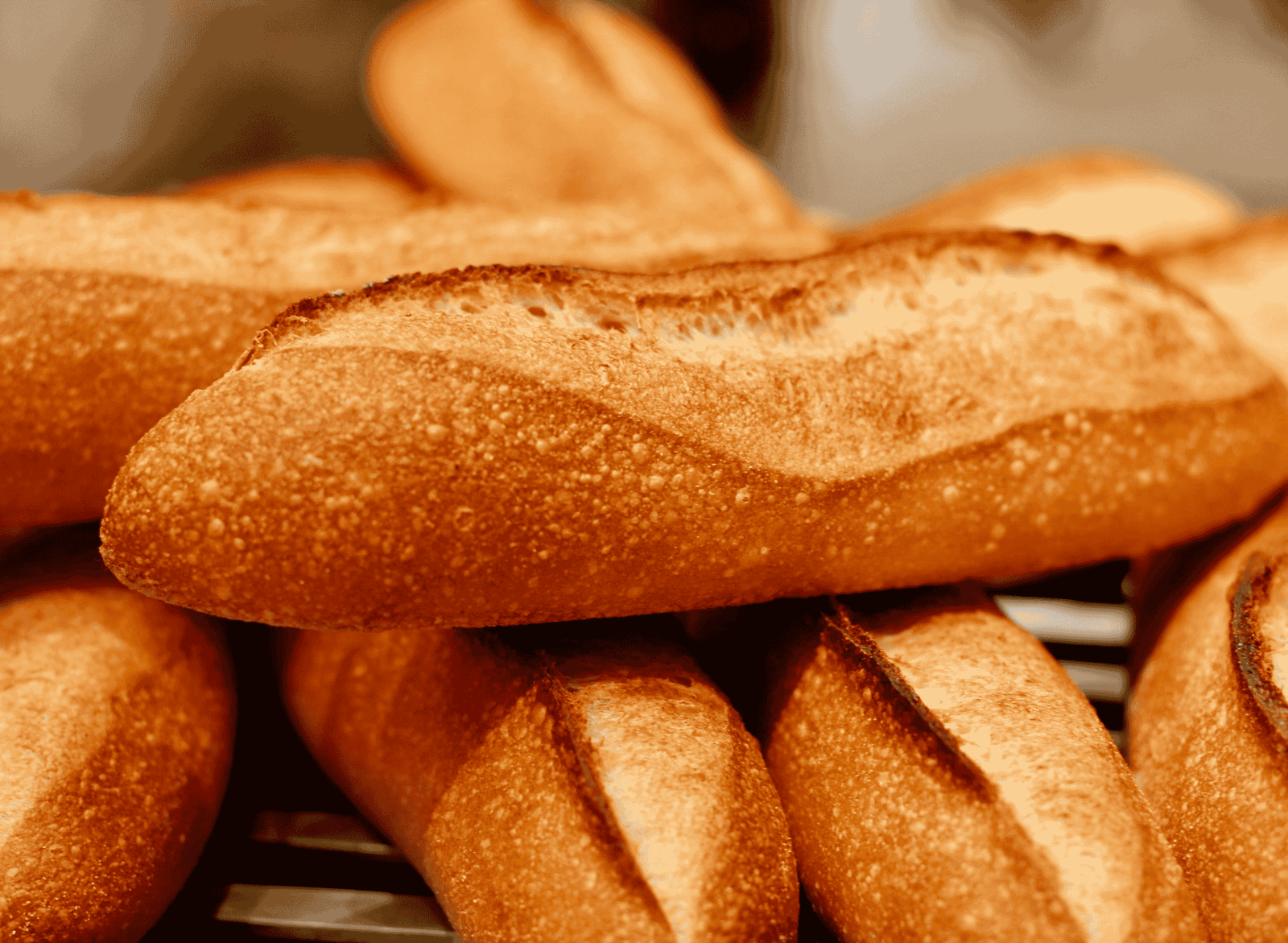
The defining characteristics go beyond mere dimensions. A proper baguette must have a crisp, golden crust that shatters when you bite into it, revealing a soft, chewy interior punctuated with irregular air pockets throughout the crumb.
The exterior should be neither too thick nor too thin, achieving that delicate balance where it provides textural contrast without becoming tough or difficult to eat. The colour ranges from pale gold to deep amber, depending on baking time and oven temperature.
Inside, the crumb should feel light and airy rather than dense or heavy. Those irregular holes throughout the interior aren’t just aesthetic; they indicate proper fermentation and gluten development, showing that the baker has coaxed the dough to its full potential.
French law actually regulates what can be called a baguette. Traditional versions must contain only wheat flour, water, salt, and yeast, with no added fats or preservatives. This legal definition protects both quality and cultural heritage.
Ingredients and Taste
The ingredient list for authentic baguette couldn’t be simpler. Quality wheat flour forms the foundation, typically a blend that provides both structure and flavour. Water hydrates the flour and activates the gluten network that gives bread its characteristic texture.
Salt enhances flavour and controls fermentation, whilst yeast provides the leavening power that creates those desirable air pockets. Some bakers use commercial yeast for consistency, whilst others prefer natural starters for additional depth of flavour.
That’s genuinely everything needed, though the proportions, mixing technique, fermentation time, and baking method all dramatically affect the final result. Great baguettes emerge from understanding how these simple ingredients interact throughout the process.
The taste of a fresh baguette is remarkably nuanced for something so straightforward. The crust delivers a toasted, slightly caramelised flavour with subtle nutty notes that develop during baking at high temperatures.
Inside, the crumb offers a gentle wheaty sweetness with mild tang, especially in loaves made with longer fermentation times. The texture plays a crucial role in the eating experience, with that contrast between crispy exterior and tender interior.
Freshly baked baguette needs nothing added to be utterly compelling. The flavour is clean and honest, allowing the quality of the wheat to shine through. However, it also serves as an excellent vehicle for butter, cheese, charcuterie, or pâté.
The bread’s neutral character means it complements rather than competes with other flavours. This versatility explains why baguettes appear at nearly every French meal, from breakfast with jam to dinner alongside coq au vin.
A Taste of History
Despite its status as a French icon, the baguette is a relatively modern invention. The elongated shape we recognise today only became widespread in the early 20th century, though the exact origins remain somewhat murky.
Several theories attempt to explain its development. One suggests that Napoleon ordered bread baked in long, thin shapes so soldiers could carry loaves more easily in special pockets sewn into their uniform trousers.
Another popular story credits the Paris Metro construction in the 1920s. Workers from different regions of France apparently fought frequently, prompting authorities to ban knives. Bakers responded by creating bread that could be torn by hand rather than sliced.
A third theory points to an Austrian baker working in Paris during the mid-1800s who introduced steam injection ovens. This technology allowed for the thin, crusty loaves that characterise baguettes, as opposed to the rounder, denser breads previously common.
What we know with more certainty is that a 1920 French law prohibited bakers from working before 4am. This made producing traditional round loaves difficult, as they required longer baking times. The thinner baguette baked faster, solving this practical problem.
By the 1930s, baguettes had become ubiquitous throughout France. The shape proved practical for urban living, fitting neatly under arms during commutes and requiring less storage space than larger, rounder loaves.
Post-war industrialisation threatened traditional baguette quality as mass production prioritised speed over craftsmanship. However, a revival movement beginning in the 1990s saw artisan bakers returning to traditional methods, using longer fermentation and quality ingredients.
Today, baguettes enjoy protected status in France. The “baguette de tradition française” designation ensures certain loaves meet strict standards, preserving both technique and cultural heritage for future generations of bread lovers.
How to Make French Baguette (French Bread)
A traditional French baguette is a symbol of France’s everyday artistry, known for its crisp crust, chewy interior, and delicate aroma. Making it at home requires patience and precision, but the reward is a beautifully rustic loaf that tastes as if it came from a Parisian bakery. See the recipe card at the bottom for printable directions
Ingredients
- 375 g strong white bread flour
- 7 g instant yeast
- 8 g fine sea salt
- 250 ml warm water (around 38°C)
- Extra flour, for dusting
Cooking Instructions
Step 1: Prepare the dough
To begin, place the flour and salt in a large mixing bowl. Dissolve the yeast in the warm water and pour it into the flour mixture. Mix with a wooden spoon or your hand until a shaggy dough forms. Avoid adding extra flour at this stage; the dough should feel slightly sticky.
Step 2: Knead the dough
Transfer the dough onto a lightly floured surface and knead for about 8 to 10 minutes until smooth and elastic. The surface should become supple and slightly tacky but not wet. This step builds gluten for a chewy interior.
Step 3: First rise
Place the dough in a clean, lightly oiled bowl, cover with a damp tea towel or cling film, and let it rise for 1 hour at room temperature or until doubled in size. Keep it away from drafts for an even rise.
Step 4: Fold for strength
Gently deflate the dough by pressing down lightly. Fold each side towards the centre and flip it over. This strengthens the dough’s structure. Cover again and rest for another 30 minutes.
Step 5: Shape the baguettes
Divide the dough into two or three equal pieces, depending on your preferred size. Flatten each piece gently, fold it lengthwise, and seal the edge. Roll from the centre outward to form a long, even cylinder about 30 to 35 cm in length.
Step 6: Second rise
Place the shaped baguettes seam side down on a floured baking cloth or parchment paper. Cover lightly and let rise for 40 to 50 minutes until nearly doubled. The dough should spring back slowly when touched.
Step 7: Preheat the oven
Preheat your oven to 240°C (220°C fan) with a baking stone or tray inside. Place an empty metal tray at the bottom of the oven to create steam later.
Step 8: Score the loaves
Using a sharp knife or a baker’s lame, make three to five diagonal slashes on each baguette. This allows controlled expansion during baking and gives the bread its signature look.
Step 9: Bake with steam
Carefully slide the baguettes onto the hot tray or stone. Pour a cup of hot water into the bottom tray to create steam, then quickly close the oven door. Bake for 20 to 25 minutes until golden brown and crisp.
Step 10: Cool and serve
Transfer the baked baguettes to a wire rack and cool for at least 20 minutes before slicing. Serve warm with butter, cheese, or soup. The crust should crackle slightly as it cools, a hallmark of a perfect French loaf.
Variations and Substitutions
- Flour substitute: If bread flour is unavailable, use plain flour with 1 tsp vital wheat gluten for improved texture.
- Yeast substitute: Active dry yeast can replace instant yeast; activate it in warm water for 10 minutes before mixing.
- Wholemeal option: Replace up to 30% of the white flour with wholemeal flour for a deeper flavour.
- Mini baguettes: Divide into four smaller portions for sandwich sized loaves.
Cooking Tips for Perfect French Baguette
- Use a baking stone or inverted tray for better heat retention and a crispier crust.
- Create steam in the oven to mimic professional bakery conditions.
- Allow the dough to rise slowly for better flavour development.
- Always use warm, not hot, water to activate the yeast properly.
- Handle the dough gently when shaping to preserve the air bubbles for an open crumb.
How to Store and Reheat
Storage Methods
Baguettes are designed for same day consumption and stale rapidly due to their thin shape and lack of fats or preservatives. If you must store one, avoid refrigeration, which accelerates staling through a process called retrogradation.
Instead, keep your baguette at room temperature wrapped loosely in a clean tea towel or paper bag. This allows the crust to breathe whilst preventing the interior from drying out too quickly. It will remain acceptable for about 24 hours.
For longer storage, freezing works surprisingly well. Wrap the baguette tightly in aluminium foil or freezer bags, removing as much air as possible. Properly frozen baguettes maintain quality for up to three months without significant deterioration.
Reheating Techniques
Reviving a day-old baguette requires gentle heat and moisture. Preheat your oven to 180°C and lightly sprinkle the exterior with water. This creates steam during heating, softening the crust without making it soggy.
Wrap the dampened baguette loosely in foil and heat for about 10 minutes. Remove the foil for the final two minutes to re-crisp the crust. The result won’t match fresh baked perfection but comes remarkably close.
For frozen baguettes, thaw at room temperature for an hour before reheating using the same method. Alternatively, you can reheat directly from frozen by adding five extra minutes to the heating time whilst keeping the foil on throughout.
A toaster works well for individual slices, though you’ll lose that full baguette experience. The direct heat crisps the cut surfaces nicely, making excellent foundations for bruschetta or simple butter and jam.
French Baguette (French Bread)
Ingredients
- 375 g strong white bread flour
- 7 g instant yeast
- 8 g fine sea salt
- 250 ml warm water around 38°C
- Extra flour for dusting
Instructions
- To begin, place the flour and salt in a large mixing bowl. Dissolve the yeast in the warm water and pour it into the flour mixture. Mix with a wooden spoon or your hand until a shaggy dough forms. Avoid adding extra flour at this stage; the dough should feel slightly sticky.
- Transfer the dough onto a lightly floured surface and knead for about 8 to 10 minutes until smooth and elastic. The surface should become supple and slightly tacky but not wet. This step builds gluten for a chewy interior.
- Place the dough in a clean, lightly oiled bowl, cover with a damp tea towel or cling film, and let it rise for 1 hour at room temperature or until doubled in size. Keep it away from drafts for an even rise.
- Gently deflate the dough by pressing down lightly. Fold each side towards the centre and flip it over. This strengthens the dough’s structure. Cover again and rest for another 30 minutes.
- Divide the dough into two or three equal pieces, depending on your preferred size. Flatten each piece gently, fold it lengthwise, and seal the edge. Roll from the centre outward to form a long, even cylinder about 30 to 35 cm in length.
- Place the shaped baguettes seam side down on a floured baking cloth or parchment paper. Cover lightly and let rise for 40 to 50 minutes until nearly doubled. The dough should spring back slowly when touched.
- Preheat your oven to 240°C (220°C fan) with a baking stone or tray inside. Place an empty metal tray at the bottom of the oven to create steam later.
- Using a sharp knife or a baker’s lame, make three to five diagonal slashes on each baguette. This allows controlled expansion during baking and gives the bread its signature look.
- Carefully slide the baguettes onto the hot tray or stone. Pour a cup of hot water into the bottom tray to create steam, then quickly close the oven door. Bake for 20 to 25 minutes until golden brown and crisp.
- Transfer the baked baguettes to a wire rack and cool for at least 20 minutes before slicing. Serve warm with butter, cheese, or soup. The crust should crackle slightly as it cools, a hallmark of a perfect French loaf.